QTI – dialogue about classroom management
QTI is an evaluation tool for developing teachers' classroom management. The name is an abbreviation of "Questionnaire on Teacher Interaction" and thus means "questionnaire about teacher interaction".
QTI provides a concrete basis for a pedagogical conversation between a teacher and his/her manager about the teaching in a particular class. It is used to examine what the teacher might adjust in their teaching.
What is unique about QTI is that you get several perspectives on the teacher's teaching. The questionnaire is completed by both students and the teacher, and the teacher completes it twice:
By comparing the three responses, the teacher gains insight into their relationship with the students from different perspectives. At the same time, the dialogue with a pedagogical leader provides an opportunity to reflect on their practice and on what might need to be changed.
By working systematically with QTI, teachers can — together and individually — become wiser about their teaching, and working with QTI can also help the school's teachers develop a shared pedagogical language about classroom management.
As a school, you can decide to use QTI based on various strategic considerations. These could be, for example, to:
Working with QTI must have leadership attention at the highest level, at least to begin with, so it can be connected to other strategic considerations.
The tool was originally developed by internationally recognised Dutch classroom-management researchers. It has been adapted to a Danish pedagogical context by Dorte Ågård.
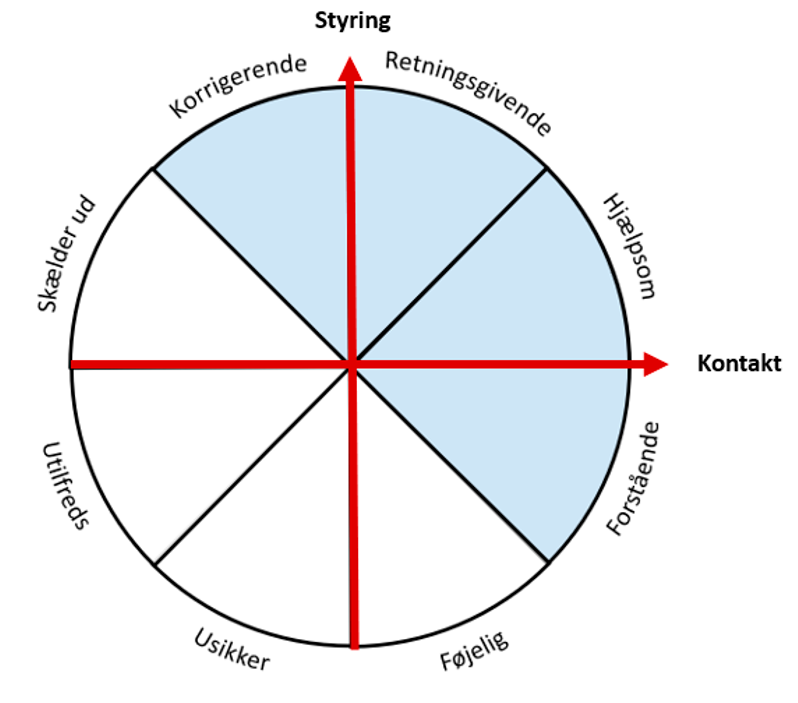
The basis for QTI is interpersonal classroom-management theory, and the core of this understanding of classroom management is the Steering-Contact model. The model illuminates the two fundamental dimensions of teachers' interaction with students: steering and contact.
The combination of the two dimensions forms a "landscape" of different facets that are always part of the interaction with students. The eight facets (octants) appear in the model below.
Classroom-management research shows that the authoritative teacher behaviour that combines good contact and high steering provides the best conditions for student motivation and academic outcome. The conclusions are based on very large amounts of data from QTI.
The underlying theory is described, among other places, in the book "Klasseledelse - fra teori til praksis" by Dorte Ågård, Marie-Louise Bach and Lene Nibuhr Andersen (2023), which can be bought here: https://forlagetcolumbus.dk/produkt/klasseledelse-fra-teori-til-praksis-1-523
QTI stands for Questionnaire on Teacher Interaction, and it is a questionnaire consisting of 32 questions. There are four questions for each of the eight octants in the Steering-Contact model: Directing, Helpful, Understanding, Compliant, Uncertain, Dissatisfied, Admonishing, Correcting. The questions give concrete examples of behaviour within the individual octants.
An example of a question is "The teacher explains everything clearly". This question exemplifies behaviour in the Directing octant. Another example is "You can go to him/her if you need help". This question belongs under the Helpful octant.
The questions come in mixed order. For each question there are five response options ranging from never to always:
The 32 questions about the interaction between teacher and students are answered three times. When the three responses have been completed, a report is generated with three graphical profiles presented together, so they are easy to compare.
They are now the starting point for a pedagogical conversation that can give the teacher useful knowledge about how the students perceive the teaching, and provide information about where there may be a need to adjust classroom management.
At the individual school you can have different purposes for using the tool. Here are some examples:
QTI is a development tool that in principle can be used by all teachers. But it must be adapted to a specific pedagogical context, so the questions reflect the typical teaching that takes place, and so they can be understood and make sense to the students. In Denmark, QTI has been developed and statistically validated for three target groups, each with its own question framework: